• Skip to primary navigation
  • Skip to main content
  • Skip to primary sidebar

Heritage and History

Buildings, plants, food and family history, culture and heritage ...

  • Contents
    • Downloads
  • Contact us
    • Website creation tools
    • About us
    • Privacy
  • Books on history, culture and heritage
  • Cookie policy
  • Cookie policy (UK)
  • Show Search
Hide Search
Home/Featured/Robert The Bruces’ Cave – Kirkpatrick Flemming

Robert The Bruces’ Cave – Kirkpatrick Flemming

A small cave formed in a red sandstone of a cliff on the Cove Estate in Kirkpatrick Flemming, is said to be the place where Robert the Bruce went into hiding on 1306.
Bruce's Cave - Kirkpatrick Flemming
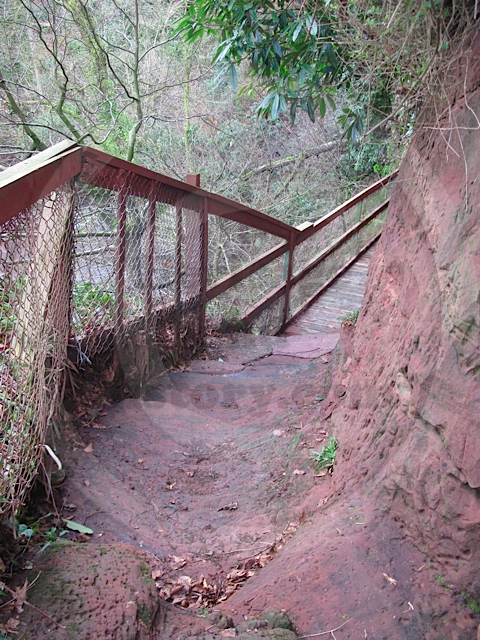
A wooden walkway provides access to the cave

Following defeat in the winter of 1306, King Robert the Bruce of Scotland went into hiding in a cave, to avoid capture by Edward I (Longshanks) of England.

Bruce and the Spider

It is said that Bruce spent three months living a solitary existence in this tiny cave and during this time, it is here that legend tells of  Bruce, watching  a spider toiling to build it’s web.

The spider would make many attempts to spin his fine threads and even when it fell, it climbed up again and carried on relentlessly until the web was spun.

Robert the Bruce, at an incredibly low point in his life, took inspiration from this little spider, encouraging him to try again.  He raised an army and went on to win the famous battle of Bannockburn in 1314, after which, he finally established his claim to the Scottish throne and thus the beginning of freedom from English rule.

The event is thought to have given rise to the saying ;”If at first you don’t succeed try, try and try again.

Gretna Cave

Small brown signs indicate the route through Kirkpatrick Flemming, just outside Gretna Green, to Bruce’s Cave.  The route proceeds into a caravan park where hand painted signs indicate a road to the left, past some old farm implements and to a parking area in front of  the estate house.

At a building to the left of the house, tickets can be obtained ( £1 each), to view the cave.  The walk proceeds down a very pleasant path surrounded by woodland, towards Kirtle River.  Continuing down a concrete stepped hill for a few hundred meters, the path turns through a gate and onto a wooden walk way which leads to the cave entrance.

Carved out of the red sandstone cliff, about 30 feet above the river, Kirtle Water, the cave is about 12 feet in diameter and only about 7 feet at it’s highest point.

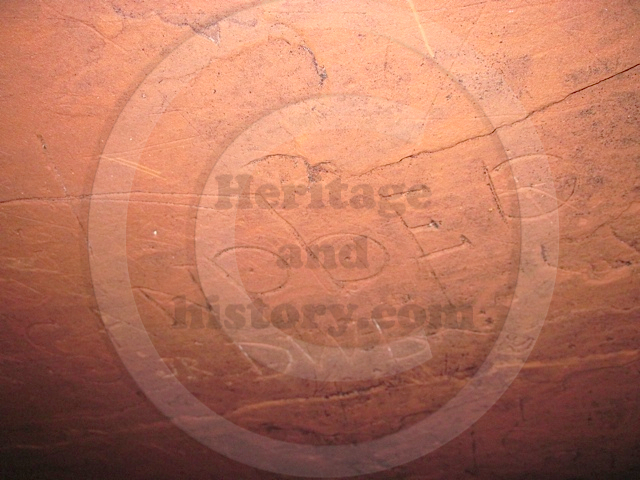
Numerous carvings and graffitti mark visits over the years, some dated around the late 1800’s.

Although access today is by a pathway provided by the local council in 1929, previous visitors had to be lowered on a rope over the overhang, from which they would swing into the cave. Needless to say, this resulted in many accidents.

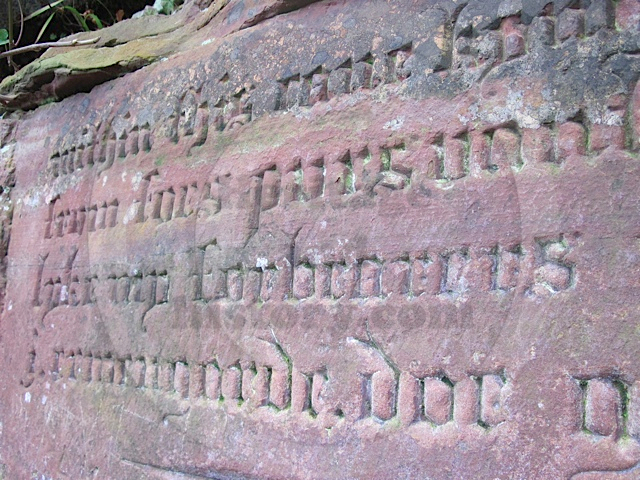
A stone inset above the cave entrance bears the following inscription;

“Within this cave King Robert the Bruce
from Foes pursuant sought a truce
like my forbears who for him fell
I Irving G and do guard it well”
Bruce's Cave - Kirkpatrick Flemming
A wooden walkway provides access to the cave
Bruce's Cave - Kirkpatrick Flemming
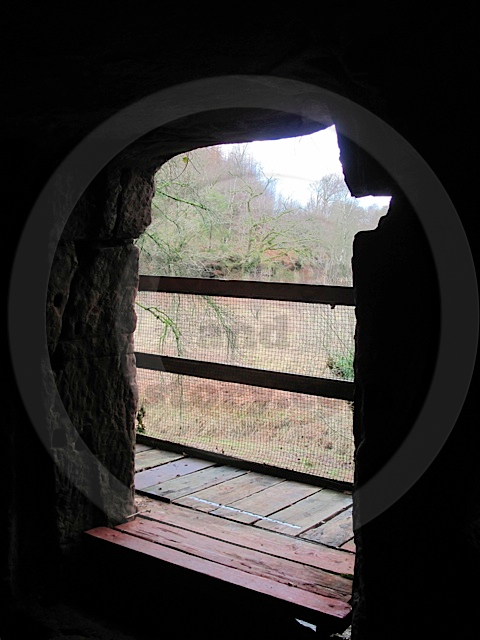
View out of the cave over the river Kirtle
Bruce's Cave - Kirkpatrick Flemming
Some visitor inscriptions seem to date back to the late 1800’s
Bruce's Cave - Kirkpatrick Flemming
Inscription on stone over cave entrance
Bruce's Cave - Kirkpatrick Flemming
A small opening leads into the cave
Bruce's Cave - Kirkpatrick Flemming
The River Kirtle lies below

Bruce’s caves

Various sites lay claim to having the cave in which Robert the Bruce hid from his foes.

Robert the Bruces’ land at Gretna was the first settlement on the Scottish side of the Solway and formed part of  Bruce’s lands in Annandale.  This cave is thought to be the likely place, as some versions of the legends talk of a local, Sir William Irving, who was hiding Robert the Bruce for three months in his secret cave.

However, the actual cave remains a mystery a mystery.  The cave at Cove Estate in Kirkpatrick Flemming is probably the strongest contender after the Irish cave on Rathlin Island, which is the one favoured by the Bruce family to this day, due to the fact that in the 14th century, the area on Rathlin Island was owned by Bruce’s Irish mother.  There is also a castle on Rathlin called Bruce’s castle which gives further credibility to the claim.

Other Scottish caves laying claim to the legend are;  Drumadoon  at Blackwaterfoot on the Isle of Arran and Craigruie near Stirling.

More Information

Bruce’s Cave – Official website of the Kirkpatrick Flemming cave.

The Bruce Trust – The Robert the Bruce Commemoration Trust’s long term aim is an innovative, living history visitor centre in Dumfriesshire dedicated to Scotland’s hero king.

Bruce Rathlin 700 – More information about how Rathlin Island features in Robert the Bruce’s story.

March 1, 2011 by admin Leave a Comment

Filed Under: Featured, People Tagged With: Army, Attempts, Battle Of Bannockburn, Brown Signs, Caravan Park, Cave Entrance, Diameter, Farm Implements, Flemming, Hairpin Turn, Inspiration, Kirkpatrick, Kirtle, Little Spider, Proceeds, Robert The Bruce Of Scotland, Sandstone, Sandstone Cliff, Scottish Throne, Solitary Existence, Spent Three, Stepped Hill, Three Months, Wooden Walkway

Reader Interactions

Leave a Reply Cancel reply

You must be logged in to post a comment.

Primary Sidebar

WWI Ruhleben Horticultural Society

Looking for Gardeners of Ruhleben

A story just published by Gardening For Health says the Royal Horticultural …

Continue Reading about Looking for Gardeners of Ruhleben

Sequoia Gigantea at Wrest Park

Perhaps the UK’s oldest recycled Christmas tree

Originally planted by the festively monikered Head Gardener of Wrest Park, …

Continue Reading about Perhaps the UK’s oldest recycled Christmas tree

Gowland Excavation 1901 (English Heritage Archive)

Who Built Stonehenge? Exhibition

A  special exhibition explores 800 years of debate about the creation of …

Continue Reading about Who Built Stonehenge? Exhibition

New Bells of Notre Dame Cathedral video

Hear the New Bells of Notre Dame

Just over 6 hours ago the new bells of Notre Dame Cathedral rang out exactly as …

Continue Reading about Hear the New Bells of Notre Dame

Staff member and inmates c 1927 Credit: National Trust

Women in the Workhouse exhibition

A fascinating ‘Women in The Workhouse’ exhibition opens on International Women’s …

Continue Reading about Women in the Workhouse exhibition

Footer

Copyright © 2026 ·Navigation Pro on Genesis Framework · WordPress · Log in

Manage Cookie Consent
We use technologies like cookies to store and/or access device information. We do this to improve browsing experience and to show (non-) personalised ads. Consenting to these technologies will allow us to process data such as browsing behaviour or unique IDs on this site. Not consenting or withdrawing consent, may adversely affect certain features and functions.
Functional cookies Always active
The technical storage or access is strictly necessary for the legitimate purpose of enabling the use of a specific service explicitly requested by the subscriber or user, or for the sole purpose of carrying out the transmission of a communication over an electronic communications network.
Preferences
The technical storage or access is necessary for the legitimate purpose of storing preferences that are not requested by the subscriber or user.
Statistics
The technical storage or access that is used exclusively for statistical purposes. The technical storage or access that is used exclusively for anonymous statistical purposes. Without a subpoena, voluntary compliance on the part of your Internet Service Provider, or additional records from a third party, information stored or retrieved for this purpose alone cannot usually be used to identify you.
Marketing
The technical storage or access is required to create user profiles to send advertising, or to track the user on a website or across several websites for similar marketing purposes.
  • Manage options
  • Manage services
  • Manage {vendor_count} vendors
  • Read more about these purposes
View preferences
  • {title}
  • {title}
  • {title}